

















































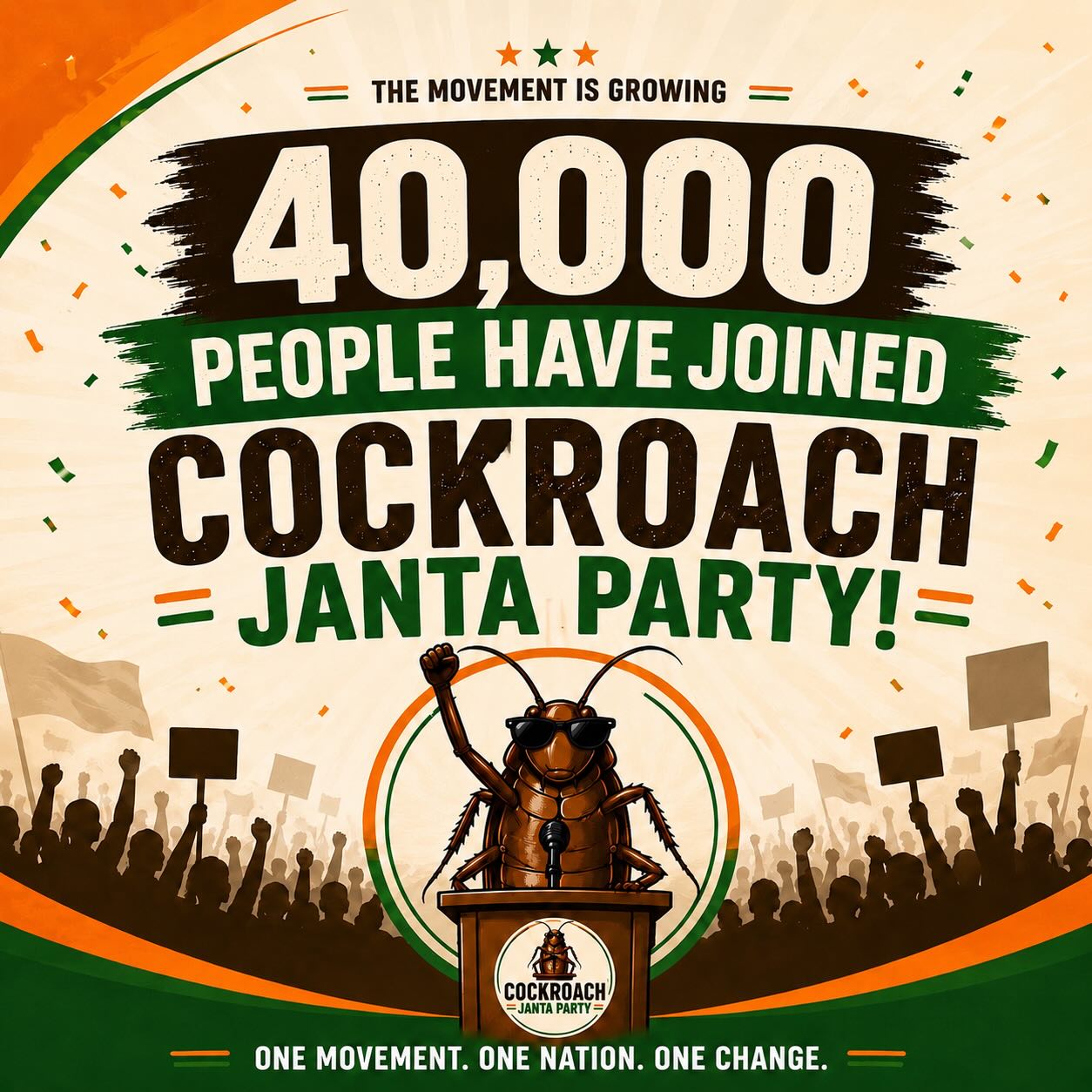
From Courtroom Insult to 16+ Million Followers: The Full Story of India’s Cockroach Janta Party

Photo Credit: cockroachjantaparty (Instagram)
| One word from India’s Chief Justice. One Google Form from a student in Boston. Five days later: 350,000 registered members, 16 million social media followers, a five-point manifesto, a Yamuna clean-up drive in cockroach costumes, a suspended X account — and a movement that has political commentators, MPs, and media organisations asking whether India’s Gen Z has finally found its political voice. Here is the complete, factual story. |
The Word That Started It All: What Did the CJI Actually Say?
To understand the Cockroach Janta Party, you have to go back to May 15, 2026, and a Supreme Court hearing about fake professional degrees in India.
During the hearing, Chief Justice of India Surya Kant made a remark that would quickly escape the courtroom and ignite the internet. He said:
| “There are youngsters like cockroaches, who don’t get any employment or have any place in the profession. Some of them become media, some of them become social media, RTI activists and other activists, and they start attacking everyone.” — Chief Justice of India Surya Kant, Supreme Court of India, May 15, 2026 |
The context of the remark matters. The CJI was expressing frustration about individuals who enter professions using fraudulent qualifications and then use platforms like RTI filings to harass the system. He later clarified that his remarks were directed at those with “fake and bogus degrees” — not unemployed youth as a general category.
But the clarification came too late. The word “cockroach” had already landed — and for millions of young Indians already grappling with unemployment, exam pressure, and a feeling of being ignored by institutions, it felt deeply personal and dismissive. Within 24 hours, the internet had turned a courtroom insult into a political identity.
Born in 24 Hours: How the CJP Was Created
Abhijeet Dipke is a 30-year-old political communications strategist currently studying at Boston University in the United States. He is also a former social media worker for the Aam Aadmi Party (AAP) — a fact that has since become a focal point of political debate around the movement.
On May 16, 2026 — the day after the CJI’s remarks went viral — Dipke posted on X (formerly Twitter), describing himself as launching “a platform for all the ‘cockroaches’ out there.” He shared a Google Form with a deliberately comic eligibility checklist: be unemployed, be lazy, be chronically online, and be able to rant professionally.
What followed was not what he expected. Dipke later said: “Well, I have been following Indian politics for a long time. When the CJI made those remarks, I put out a satirical post on X. It started with a simple Google Form, and honestly, I never expected such a massive response.”
He built the party’s visual identity, manifesto, and website within 24 hours, using AI tools including Claude and ChatGPT to accelerate the process. The website went live under the tagline: “Voice of the Lazy and Unemployed.”
| 👁️ | 16M+ | Social media followers gained within five days of launch |
| 📝 | 350,000+ | Registered sign-ups through the CJP website |
| 📱 | 15M+ | Instagram followers — surpassing the ruling BJP’s official page (~9M) |
| ⏱️ | 24 hrs | Time taken from first post to full website, manifesto, and symbol |
| 📤 | 42,000+ | New followers gained within 2 hours of relaunching after X account suspension |
What’s in the Name? The Deliberate Symbolism of ‘Cockroach Janta Party’
The name is not accidental. Every word in “Cockroach Janta Party” was chosen to carry meaning:
- Cockroach — Reclaiming the insult. The CJI used the word as a slur. The movement wore it as a badge, following a long tradition of marginalised communities reclaiming derogatory labels to strip them of their power.
- Janta — A deliberate echo of ‘Bharatiya Janata Party’ (BJP), India’s ruling party. By swapping ‘Bharatiya’ for ‘Cockroach,’ the name becomes a satirical mirror of the political establishment.
- Party — Signals political intent, even within a satirical frame, distinguishing CJP from a mere meme account or protest hashtag.
The party’s slogan — “Secular, Socialist, Democratic, and Lazy” — adds a fourth word to the Preamble’s famous trio, turning a constitutional phrase into a self-deprecating joke that simultaneously references the seriousness of the underlying issues.
Its official voting symbol is a mobile phone — a nod to the digital generation. Its declared headquarters: “Wherever the WiFi works.”
The Five-Point Manifesto: What Does CJP Actually Want?
Beneath the satire and the memes, the Cockroach Janta Party has published a five-point manifesto with substantive policy demands. This is where the movement becomes more than a joke:
| #1 | Ban on Post-Retirement Rajya Sabha Appointments for Judges No retired Chief Justices or Supreme Court judges should be appointed to the Rajya Sabha or given government positions after retirement. CJP argues this blurs the line between the judiciary and the executive. |
| #2 | Accountability for Voter List Manipulation The movement demands investigation and transparency around allegations of voter roll irregularities, which have been raised by opposition parties and independent electoral observers. |
| #3 | Reform of Corporate Media Capture CJP calls for measures to address what it describes as a ‘largely pliant corporate media’ — a concern about editorial independence that has been raised by press freedom organisations internationally. |
| #4 | Youth Employment Policy Reform Concrete government action on graduate unemployment, which government data places at approximately 9.9% for those aged 15–29, with urban youth unemployment at 13.6%. |
| #5 | Institutional Accountability Broader transparency and responsiveness from government institutions — including the judiciary — toward citizens who use formal tools like RTI to engage with governance. |
| Important context: The Cockroach Janta Party is NOT a registered political party. The Election Commission of India has not recognised it. It cannot contest elections under its current name. Some supporters have discussed contesting the upcoming Bankipur Assembly by-election in Bihar, but no formal steps have been taken to register as a party. |
Why Did It Go Viral? The Real Economic Anxieties Behind the Meme
The speed of CJP’s growth — 16 million followers in five days — cannot be explained by the founder’s personal following or any single media coverage. It tapped into something real and pre-existing.
India is the world’s most populous nation, with approximately 65% of its 1.42 billion people under the age of 35. That is an extraordinary concentration of young people. And the data on their circumstances is sobering:
- Youth unemployment (15–29 age group): 9.9% nationally (2025 government data)
- Urban youth unemployment: 13.6%
- Graduate unemployment rate: approximately 29% (various estimates)
- Growing concern that AI will disrupt entry-level roles in India’s vast IT services and back-office industry
- Widespread frustration over exam paper leaks — with nationwide student protests in the same week as the CJI’s remarks
The CJI’s comments arrived in this context. To millions of young Indians who feel the system is not working for them, a Supreme Court judge calling them “cockroaches” confirmed a suspicion they already held: that the institutions designed to serve them regarded them with contempt.
| “The biggest takeaway from the response is that young people in India are frustrated since no political party has done anything for them in the last few years. I think that is precisely why all have signed up as cockroaches.” — Abhijeet Dipke, CJP Founder, quoted by The Week, May 2026 |
Who Is Abhijeet Dipke? The Background of CJP’s Founder
Dipke is a 30-year-old from India currently pursuing a Master’s degree at Boston University. He describes himself as a political communications strategist and digital content creator, and has a history of following Indian political developments closely from abroad.
Before his studies, he worked as a social media professional for the Aam Aadmi Party (AAP). This background has been the single most discussed fact about him since CJP went viral, with supporters and critics drawing very different conclusions from the same information. Dipke has been open about how the movement came together: it was impulsive, not strategic. He read the CJI’s remarks, posted on X, and the response overwhelmed him. He used AI tools to build the visual identity and manifesto quickly. He did not predict the scale. He has also faced caste-based attacks online following his rise to prominence, which The Print documented in a widely-read report
How Has India Responded? Voices From All Sides
Political Support
The movement attracted attention from across the political spectrum, though predominantly from opposition voices:
- MPs Mahua Moitra (Trinamool Congress) and Kirti Azad both expressed interest in joining the party — a notable signal of cross-party appeal beyond the AAP connection.
- Prashant Bhushan, prominent Supreme Court lawyer and rights activist, told Al Jazeera that the CJI’s remarks “reflected deep-rooted prejudice and antipathy towards activists and youth in general.”
- Maadhyam, a media advocacy organisation, expressed public support for the movement’s goals.
Critical Perspectives
Not everyone has embraced CJP uncritically. A number of serious questions have been raised:
- AAP connection: Dipke’s prior work for AAP has led many commentators and social media users to question whether the movement carries a partisan agenda, even if unintentionally.
- Sustainability doubts: Multiple analysts have compared CJP to previous viral political moments in India that faded quickly. Whether a satirical movement can develop into lasting political organisation remains deeply uncertain.
- Registered party question: Without ECI registration, CJP cannot contest elections. Some critics argue the movement functions more as political pressure and brand-building than as genuine party formation.
- Bot and authenticity questions: Some observers have questioned the composition of CJP’s rapidly accumulated social media following, noting that explosive growth of this kind in compressed timeframes often includes inauthentic accounts, though no verified audit has been published.
Media and Cultural Commentary
YouTuber Meghnad S, who hosted Dipke for a widely-watched stream, told Al Jazeera that “the joke has taken a life of its own” and that he was receiving messages from Gen Z users asking how to take the movement forward. He described an “overwhelming sense” of young people looking for direction.
Commentators have placed CJP in a global tradition of satirical political movements that use absurdist humour to make serious points: from Italy’s Five Star Movement in its early years, to Iceland’s Best Party, to the UK’s Official Monster Raving Loony Party. In each case, the satire was the vehicle; the frustration was the fuel.
The X Account Suspension: What Happened and What Followed
On May 21, 2026, CJP’s official X account was withheld — making it inaccessible to users in India. The suspension came after Dipke had already reported attempts to hack the account the previous day.
Dipke’s response was immediate and characteristically sardonic. He launched a new account named “Cockroach Is Back” and posted: “You thought you can get rid of us? Lol.” Within two hours, over 42,000 people had subscribed to the new account.
He described the suspension as “a self-goal by the government” — arguing that the action gave the movement more attention and sympathy than it had before. He also said the CJP would pursue the matter legally.
X has not publicly explained the reason for the account’s withholding. In India, X accounts can be withheld in compliance with government legal orders, though this is not confirmed in this case.
| Platform Note: Account withholding on X in India typically occurs when the platform receives a legal order from the Indian government under the IT Act. X publishes such orders periodically in its transparency reports. Whether the CJP withholding involved such an order had not been officially confirmed at the time of publication. |
Is This a Genuine Movement or an Internet Moment?
This is the central question that political analysts, journalists and ordinary observers are asking. The honest answer is: it is too early to know, and it may be both simultaneously.
Certain things are factually clear. The movement is real in the sense that millions of real young people responded to it. The offline Yamuna clean-up drive — volunteers dressed in cockroach costumes cleaning a river that successive governments have failed to restore — was a tangible act of civic engagement, not just a social media post. The manifesto addresses genuine, documented issues.
At the same time, the movement’s long-term viability faces structural challenges. Without ECI registration, it cannot contest elections. Without an organisational structure beyond social media, it cannot sustain pressure over time. And the history of viral political moments — in India and globally — shows that most of them dissipate quickly without converting attention into institutions.
What the Cockroach Janta Party has unambiguously done, regardless of what happens next, is give a name, a symbol, and a slogan to a generation of young Indians who feel the political system does not speak for them. Whether someone converts that sentiment into lasting political change is an open question — and possibly the most interesting political story in India this year.
Frequently Asked Questions
Who founded the Cockroach Janta Party?
Abhijeet Dipke, a 30-year-old Boston University student and former Aam Aadmi Party (AAP) social media worker, founded the CJP on May 16, 2026 — one day after CJI Surya Kant’s remarks went viral.
What did the Chief Justice of India actually say?
During a Supreme Court hearing on fake professional degrees on May 15, 2026, CJI Surya Kant said: “There are youngsters like cockroaches, who don’t get any employment or have any place in the profession. Some of them become media, some of them become social media, RTI activists and other activists, and they start attacking everyone.” He later clarified the remarks were directed at those with fake degrees, not unemployed youth generally.
Is the CJP a real registered political party?
No. The Cockroach Janta Party is not registered with the Election Commission of India and cannot currently contest elections under its name. Some supporters have discussed contesting the Bankipur Assembly by-election in Bihar, but no formal registration process has been initiated.
What are the CJP’s five demands?
The five demands are: (1) Ban post-retirement Rajya Sabha appointments for judges; (2) Accountability for voter list manipulation; (3) Reform of corporate media capture; (4) Youth employment policy reform; and (5) Broader institutional accountability and transparency.
Why was CJP’s X account suspended?
CJP’s X account was withheld in India on May 21, 2026. Dipke stated this followed attempted hacking the previous day and called it “a self-goal by the government.” He launched a new account, ‘Cockroach Is Back,’ which gained over 42,000 followers within two hours. X has not publicly confirmed the reason for the withholding.
Does the founder’s AAP background make CJP a partisan movement?
This is genuinely contested. Dipke worked for AAP previously but founded CJP as an independent satirical movement. Support has come from MPs across parties — including Trinamool Congress — not only from AAP. Critics argue the AAP background creates a conflict of interest; supporters argue that someone’s professional history does not automatically define their independent work. Readers can weigh this evidence and reach their own conclusions.
Disclaimer: This article is for informational and educational purposes only. It is based on publicly available reports and policy updates. It should not be considered financial, investment, legal or business advice.